
Showing posts with label Tax. Show all posts
Tax Policy to Reduce Poverty: Outlook for Temporary Expansions to CTC & EITC

By Andy Nielsen
Congress is currently considering a sizable piece of legislation
- the Build Back
Better Act. The bill is politically feasible thanks to a wonky federal
budget law that allows for budget
reconciliation, and would have a transformative effect on
individuals, families, and children across the United States. Two provisions
that the Indiana Institute for Working Families has been tracking closely are
the current expansions to the federal Child Tax Credit (CTC) and Earned Income
Tax Credit (EITC). As noted in previous posts (CTC
& EITC),
these changes are effective for 2021 only, so Congress will need to take action
or else these important reforms to our tax code will expire. The good news? The
Build Back Better Act steps up to the plate.
CTC:
The Build Back Better Act extends the changes made to the CTC in
the American
Rescue Plan (ARP) through 2025. This includes increasing the amount
of the credit for children in some households and the option to receive part of
the credit through advance monthly payments. However, the Build Back Better Act
goes even further by making the credit permanently refundable – you can find a
refundability primer on an earlier blog post here
– allowing low-income families to capture the full value of the credit. This is
extraordinary news for families and households who need it the most.
The bill also eliminates the Social Security Number (SSN)
requirement for children, allowing children with Individual Tax Identification
Numbers (ITINs) to be eligible for the credit. This is not as much a change as
it is a reversion to previous law before the enactment of the Tax Cut &
Jobs Act, which established a SSN requirement. Approximately 11,000 additionalchildren in Indiana would be eligible for the CTC under this change.
Households have until November 15, 2021 to sign up for advance payments. In
September, 2.3 million Hoosier children in 1.3 million households
received advance payments.
EITC:
The Build Back Better Act also makes permanent the ARP’s changes
to the federal EITC, expanding benefits to childless workers and widening the
eligible age range to include younger and older workers. While this is
encouraging news, Congress should seriously consider addressing some of the
remaining issues such as expanding
the credit to all adults, including those with ITINs, and eliminating
the marriage penalty.
Outlook /
Next Steps:
Last week, the House
Committee on the Budget combined the various components of the Build Back
Better Act into one single piece of legislation and reported the bill out of
committee. This incorporated CTC and EITC expansions included in the House Ways
& Means Committee (discussed above). What is next is far from certain.
Larger debates on avoiding a government shutdown, bipartisan infrastructure
legislation, emergency funding to address the damage from Hurricane Ida, and
raising or suspending the debt ceiling complicate the future of the Build Back
Better Act. However, federal lawmakers have a duty to clear the deck and
deliver, especially when it comes to public policy that will have a meaningful
impact on people’s lives.
Tag :
Tax
Tax Policy to Reduce Poverty: Federal EITC Expansion Moves toward Parity

By Andy Nielsen
The federal tax code is getting a lot of attention lately. There
has been particular focus on the expanded Child Tax Credit (CTC) and the new
feature that allows families to capture the credit through advance monthly
payments. This attention is for good reason given the impact it will have on
Hoosier families and children, which we recently
discussed at length. The CTC dramatically changed through the American
Rescue Plan (ARP), which also included an important change to the
Earned Income Tax Credit (EITC). Specifically, the ARP expanded the EITC for
childless adults by (1) allowing younger and older working adults to claim the
credit, (2) increasing the maximum credit, and (3) raising the income threshold
at which the credit phases out (for otherwise eligible workers).
Prior to the ARP, childless
workers were eligible for the EITC only between ages 25 and 64. The ARP reduced
the eligible age to 19 for most workers. Students attending school at least part time
are now eligible at age 24, and foster children and homeless youth are eligible
at age 18. The new law also temporarily eliminated the maximum age for
childless workers, allowing workers 65 and older to claim the credit in 2021.
And yes, 2021 only. Similar to the CTC, these changes to the EITC are temporary.
The ARP increased the maximum credit for childless workers in
addition to phasing in the credit more aggressively and phasing the credit out over
a higher income. See below:

Source: Congressional Research Service (Link)
Over
367,000 Hoosier workers without children would benefit from this expansion
each year, of whom over a quarter are non-White. Approximately
11.4% of Hoosiers would receive a federal tax cut of $690 on average in 2022, providing
meaningful relief to individuals who need it the most to meet their basic
needs.
While these changes will affect working Hoosiers in a demonstrable way, it is not without unintended consequences and pitfalls. As Congress and the President work to make changes to the EITC permanent, it will be crucial that they eliminate the marriage penalty and extend eligibility to all young adults – regardless of their school enrollment status. Congress and the President have the opportunity to recalibrate our tax code in favor of people. Now is the time to get this right and build upon the work already done.
Tag :
Tax
Tax Policy to Reduce Poverty: Critical Resource to Help Hoosier Families Meet Their Basic Needs

By Andy Nielsen
A global pandemic can change a lot about our daily lives. And a
lot has changed in the past 16 months. While low-income families regularly
experience the brunt of the negative effects stemming from economic and public
health crises, several federal policy changes from earlier this year will help
ensure families have a chance to recover. Believe it or not, these changes come
through our tax code.
Predictably, households with children are more likely to
experience difficulty covering basic living expenses – such as rent, food,
utilities, clothing, childcare, and transportation – than those without
children. Combined with pressures stemming from slow-to-nonexistent wage
growth, there is little surprise that low-income families with
children struggle to get by. That is why the recent changes to the Child Tax
Credit (CTC) will make an immediate and considerable impact on children and
families that need it the most.
Earlier this year, Congress passed and the President signed the American
Rescue Plan (ARP) that dramatically changed the CTC in several
ways. First, the ARP
increased the existing $2,000 per child CTC to $3,600 per child under age six
and to $3,000 per child age six and over for low-income families. It also made sure that all minor children are actually eligible
by increasing the maximum age of dependent children from 16 to 17-years-old. However,
the two most important features of the credit may very well be that (1) the CTC
is now fully refundable and (2) the credit can be received through advance
monthly payments.
Refundability:
We discussed in a previous
post
about the importance of refundable tax credits, especially for low-income
families. Prior to the ARP, low-income families would not capture the full
value of the credit because it only covered their remaining tax liability after
other credits and deductions. Those without tax liability or a filing
requirement received nothing at all. So, while the maximum possible CTC per child
was the same for all earners (below a certain income threshold), non-refundability
meant that the tax credit was subsidizing more child rearing costs for
higher-income versus lower-income taxpayers, making the effective tax credit much
smaller for families that needed it most. A fully refundable credit closes that
discrepancy for low-income and no-filer households.
Advance
Payments:
The advance monthly payment option is a welcome feature that
will go a long way in helping families meet their basic needs. Starting
July 15, 2021, the Internal Revenue Service (IRS) will begin
providing half of a family’s total CTC (for all eligible children) through
advance monthly payments. Families will claim the second half of their total
CTC when they file their 2021 tax returns.
Families that are not required to file a 2020 tax return or
don’t plan to, can sign up to receive their advance payments through the IRS’ Child
Tax Credit Non-filer Sign-up Tool. This non-filer tool is especially
important for Indiana given an
estimated 41,000 Hoosier children live in households that may not have filed a
2019 or 2020 tax return.
These advance monthly payments are estimates of a family’s total
eligibility for the CTC using the most recent data on file with the IRS. So if
a family’s income has substantially changed in 2021, they should use the IRS’ Child
Tax Credit Update Portal to update their income. This is important as families
that approach the threshold where the CTC begins to phase out may be at risk
of overpayment. However, this risk is substantially hedged as, again, only
half of a family’s estimated CTC can be redeemed through advance payments, and
families can opt out of the payments using the Non-Filer Tool. It is also
important to note that this is a tax credit and not income, so advance
payments will
not affect a family’s eligibility for other social safety net programs like
Medicaid, Supplemental Nutrition Assistance Program (SNAP) benefits, or
Supplemental Security Income (SSI).
The impact of these changes on Hoosier families will be
astounding. Approximately, 558,000
additional children will now benefit from the tax credit. A majority of
these children – 323,000 – live in
rural areas of our state. These changes will reduce child poverty by 43%, lifting
78,000 Hoosier children out of poverty. Statewide, 1.45
million children (92%) will now benefit from the CTC.
Again, these changes are currently effective for tax year 2021
only, so the need for permanency is already clear. There will undoubtedly be
hiccups with this historic change to our social safety net, yet hopefully, it
will lead to subsequent policy changes that will promote equity and remedy any
issues. For the time being, families need to file their 2020 returns or use the
IRS’
Non-Filer Tool to begin receiving their advance payments.
Tag :
Tax
Tax Policy to Reduce Poverty: Changes to State EITC a Win for Hoosiers

By Andy Nielsen
In a legislative session dominated by the biennial budget and pandemic response, Indiana lawmakers took an important step to strengthen our state’s social safety net for many Hoosiers across the state. House Enrolled Act 1009 increased the state’s Earned Income Tax Credit (EITC) from nine percent to ten percent of a taxpayer’s federal EITC, which had been largely untouched since 2011. Many thanks to our lawmakers for recognizing the effectiveness of this tried and true tool to help combat poverty in Indiana.
The federal EITC was created in 1975 as a tool
to incentivize work, boost earnings, and combat poverty. Eligibility and the
amount of the credit are a function of a taxpayer’s earned income, filing status,
and the number and age of children claimed on the tax return. Simply put: the
more you (and/or your spouse) work, the higher the credit, and once you earn a
certain amount, the credit begins to phase out. Have kids? Then you may receive
a larger credit.
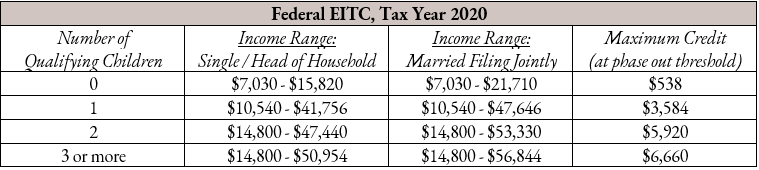
The federal credit phases out at a higher income for married
couples filing jointly compared to individuals filing single or head of
household. However, the maximum credit is determined by the number of children
(under age 19 or 24 if full-time student and must have a valid SSN) claimed on
the return and whether or not the filer is single or married. The table below
illustrates these differences. Income ranges provide the minimum earned income
to receive the maximum EITC and the maximum amount where credit is zero (completely
phased out).
Source: Congressional Research Service (Link)
The federal EITC has been extremely effective at combating
poverty and is quite popular. In 2018,
the credit lifted approximately 5.6 million people out of poverty – including
about three million children. Data from the Internal Revenue Service
(IRS) for tax year 2019 demonstrates the credit’s popularity with about 25
million individuals and families nationwide receiving an average EITC of around
$2,461, including 515,000 Hoosiers with an average credit of $2,424. Unfortunately,
only 78% of
eligible taxpayers (79.8% in Indiana) claimed the federal tax credit in 2017. To put
this in perspective, nearly 135,000 additional Hoosiers were eligible but did
not claim the credit – that’s over $324 million gone unclaimed.[1]
One of the more important features of the credit is that it is
fully refundable, meaning the "unused" portion of the credit is recouped through
a refund at tax time. A quick refresher on tax credits. Unlike tax deductions
that lower taxable income, tax credits offset tax liability dollar-for-dollar.
Say you owe $2,000 in taxes and have a $2,400 credit. If the credit is
refundable, your tax liability is reduced to $0 and you receive the remaining
$400 of the credit as a refund on your return. If the credit is non-refundable,
the remaining $400 is left on the table. Refundability ensures the credit is
fully realized by low-income taxpayers who may reduce their tax liability to
zero through other credits or deductions.
In 1999, Indiana followed the federal government’s lead by
creating its own EITC. While the credit was modified several times and remains
decoupled (stay tuned for future blog post) from its federal counterpart, the
state credit is still an
important tool for Hoosiers. Like the federal EITC, Indiana’s credit is
fully refundable, making it among the
most effective and targeted tax reduction strategies to help offset regressive
state taxes. According to an analysis provided by the Institute
on Taxation and Economic Policy (ITEP), recent
changes (effective tax year 2022) made to Indiana’s EITC in the 2021 Legislative Session will
provide a tax cut to 13 percent of Hoosiers (see table below). Again, this is
an important change and a moment to celebrate the legislature’s efforts towards
a stronger social safety net, but we need to keep up the momentum.

Looking ahead, Indiana needs to focus even further on using the tax code to strengthen Hoosier households and families. Given the substantial changes made to the federal EITC, Indiana lawmakers should create parity between the federal and state credits, which would be a critical step towards further improving the livelihoods of our most vulnerable fellow Hoosiers.
[1] Author’s calculations using participation rates and individual income and tax data from 2017 IRS data.
Tag :
Tax


